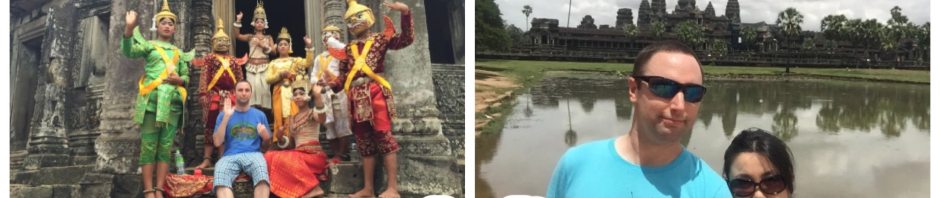
The first time I went to Cambodia was still one of my my most memorable trips as it was such a laugh travelling with mates but there were a few things I never really got to experience. Needing a greater appreciation and understanding of Cambodian history, culture and cuisine as well as taking in a few new places, I decided to return to the South-East Asian country about nine years later with my wife.

Day 1: Having arrived the night before, we spent our only full day of the trip in the capital city of Phnom Penh. It was also my birthday but it was a very sombre start as it began with Choeung Ek a.k.a. the Killing Fields; a grim place where many monstrosities took place in the late 1970’s under the Pol Pot regime.
Our $6 entrance fee included a listening device which was essential for this tour as otherwise you’d just be someone standing in what is now a peaceful field with chickens roaming freely amidst the swaying branches of the trees and cool breeze passing through the area. That’s a far cry from four decades ago when about 17,000 people were exterminated on the same site.
Barbarous, cruel crimes were committed by the ultra-communist Khmer Rouge regime on this site including a chemical substances store room, killing tools storage room, the executioners’ working office, the bones of victims and the graves. The finale is a the Memorial Stupa; a building possessing the skulls of over 8000 victims.

Our tour of Cambodia’s depressing past continued back in the city at Tuol Sleng Genocide Museum which was more visually disturbing as it was more in-your-face and each visitor is confronted with the conditions that each prisoner suffered. It used to be a high school before becoming the notorious Security Prison 21 (S-21) from the Khmer Rouge regime between 1975 and 1979.

The site has four main buildings (galleries, cells and instruments for torturing and killing prisoners) which are preserved as they were left when the Khmer Rouge were driven out in 1979. Eventually, they ran out of space and from the end of 1976 the prisoners were taken to the aforementioned killing fields to be sentenced to death.

After a very sombre morning I was in need of a beer and some food so we went to a local restaurant beside the Tonlé Sap River to reflect on what we’d seen that day and move on to some more pleasant ways to spend my birthday. The picturesque Royal Palace and Silver Pagoda followed afterwards.

To celerbrate my birthday, we went to the night market and to get some Khmer food. It was the first day of the Premier League season in England and I was surprised to find a bar showing Leicester’s home match which ended in a wonderful 4-2 victory. Leicester would miraculously go on to win the league that season!
Day 2: A seven hour bus ride from Phnom Penh to Siem Reap took up the majority of our day. Travel sickness is a common problem for my wife on such journeys so we did not take another bus after this!
Day 3: We got on the road later than planned having borrowed bicycles from our hotel to cycle round four of the most famous spots. We got our $40 passes (a 3-day pass not that we would be using it beyond two days!), and arrived at Angkor Wat just before lunchtime on a blisteringly hot day.

Angkor Wat is the world’s largest religious building and the first stop for many visitors not only due to it’s fame but also because of it’s location. The attention to detail in the sandstone bricks is so impressive and it really is hard to believe how such a place was ever built.

Back in 2006 we were quite surprisingly allowed to climb all over the structures and the steps were frankly asking for trouble as they were so steep and dangerous. However, nearly a decade later, and boardwalks and wooden steps had been implemented for safety and preservation reasons.

Phnom Bakheng was a new sight for me. This is an incredibly popular place for tourists to photograph Angkor Wat at sunrise and sunset and despite us being there early afternoon there were already a couple of people hanging around for sunset!

Angkor Thom was next and during that ride I realised that the temples weren’t quite as close in reality as they were in my mind. It’s a spectacular entrance with giant statues of gods and demons with a moat beneath.

The many enigmatic faces of Bayon provides the centrepiece of Angkor Thom where a lot of climbing was done around it’s three levels as we sweated it out in the heat.


The eerie Ta Prohm (a.k.a. the ‘Tomb Raider‘ one) seemed to take forever to get to and was like a maze. Without a map to hand we found it quite hard to locate some of the more famous spots within the complex which has been swallowed by the jungle. Eventually we managed to find the iconic tree root areas where trees are growing out of the ruins.

Day 4: As nice as the previous days cycle tour of the main temples was, it didn’t really offer anything too new for me so I was more excited about doing the Grand Tour Circuit via tuk-tuk. However, we first returned to the Angkor Thom vicinity as we wanted to see it again as we didn’t have enough time the previous day to explore much beyond Bayon.

The so-called lesser temples of Angkor are just as worth visiting as the main ones, and are far less crowded. We visited over a half a dozen of them and, though we did get a bit tired, they were all very interesting in their own unique ways with a couple of them similar in appearance to the over-popular ‘Tomb Raider‘ one!

The final place on that tour was the brick-built Prasat Kravan which I actually went to in 2006 whilst stupidly attempting to walk between Ta Prohm and Angkor Wat! My friends and I didn’t quite realise the scale of the map back then! A short time after leaving there to head back for a much-needed dip in our hotel pool, our tuk-tuk got a puncture which thankfully our driver Sna managed to get repaired nearby relatively quickly.

Day 5: Put off by the seven hour bus ride that took us from Phnom Penh to Siem Reap we decided time (and comfort!) was of greater importance than money so flew back to the capital ($80) and then took a taxi to Kampot ($45). We were already in the sleepy river town by 1:00 pm instead of arriving late at night if we’d taken a couple of buses. It was a great idea as it was air-conditioned door-to-door service with a driver that spoke good English and could talk about present and past life in Cambodia.

Kampot was a place that was just nice to wander round with wide roads, limited traffic and many dilapidated French-era buildings. We visited the Old Bridge (a strange mix of varying structures having been destroyed during the Khmer Rouge period), the local market, a Durian Monument, a Vietnam-Cambodia Friendship Monument, the Kampot Olympic Stadium, the lake and the old prison as well as just observing local street life.

Day 6: The main reason for going over to Kampot was to visit the Bokor Hill National Park area located 45 minutes away. A few abandoned buildings kicked things off with the first one being a former royal residence.


Next was a former fruit shop and a couple of other building ruins that had some beautiful bright features within the derelict walls.

The giant holy statue of Lok Yeay Mao Monument stands tall and overlooks the area. Many locals give offerings of flowers and food and pray to Lok Yeay Mao in return for a safe journey onwards or homewards.

After a bright sunny morning, Le Bokor Palace (a.k.a. the Old Casino Hotel) was completely covered in mist when we arrived. Once the mist descended, it began to appear giving it a perfectly eerie feeling akin to how it was portrayed in films like ‘City of Ghosts‘ (2002) and ‘R-Point‘ (2004).
The construction of this French colonial settlement began in 1917 and took eight years to complete. The location was chosen for the slightly cooler climate as it’s atop a lush green forested mountain 1,080m above sea level. It was built as a resort for the French social elites living in Cambodia who needed to escape from the humidity and heat elsewhere.

The Palace has experienced a lot over the years ranging from French dignitaries having lavish ballroom dances to the ruling Cambodian elite in the 60’s, and in the late 70’s it was occupied by the Khmer Rouge and used as a prison. A temple perched right on the edge of the cliff with a huge drop down to the sea beneath finished off our tour.

Day 7: Unlike my previous visit I was actually more interested in spending a bit of time in Phnom Penh so after a taxi returned us to the city we went out to get some food and I had beef brain noodle soup!

The final place of note was the National Museum which had a wonderful courtyard with four pavilions surrounding the beautiful garden.

The temples of Ankor are of course what draws tourists to Camobodia but beyond that are a number of other destinations and experiences offering great insight into the fascinating culture of a country which has suffered in the past but you wouldn’t know it when you experience the warmth and pride of it’s people.
Click here to read ‘The Northern Delights of Vietnam – Hanoi, Sapa & Halong Bay (2013)’
Click here to read ‘Travelling To A Trio Of Top Places In The Lovely & Often Overlooked Laos (2008)’
Click here to read ‘On Screen #7 – Cambodia’
Click here to read ‘Cambodia Filming Locations: Lara Croft Tomb Raider (2001)’

 Tokyo Fox (東京狐)