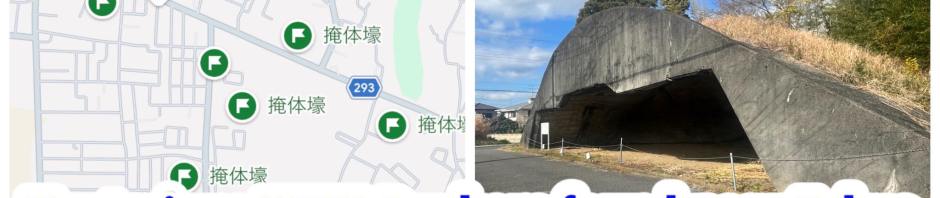
As memories of WWII gradually fade, its relics offer us a glimpse of what it was like back then and it is hoped that such remnants of the war will be preserved for future generations. There are a few examples dotted in and around Tokyo such as a damaged building in the western provinces of the capital and Saitama’s remains of the Japanese Army’s military facility and cliff tombs. On top of that, half a dozen bunkers are located within easy reach of central Tokyo and I recently visited them.
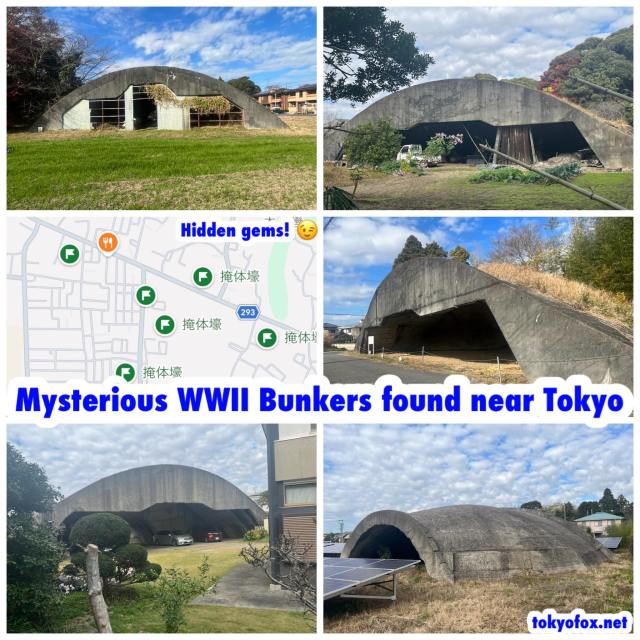
During the war, such bunkers were built as storage facilities and to protect fighter planes from enemy attacks. Incredibly they are still scattered throughout a city in Chiba, the prefecture which borders the eastern side of Tokyo. Recently, their necessity has begun to be discussed and the 80th anniversary of WWII ending is a time to reflect on their preciousness.
About 75 minutes south-east of Tokyo station is the city of Mobara which was established as a base for a fighter aircraft unit of the Imperial Japanese Navy (IJN) during WWII. Shim-Mobara station on the Sotobo Line is the best way of accessing these bunkers via public transportation, and at the end of November last year, I walked round a cluster of them. For all I know there may be more than the six listed here but the ones I visited began with the Former Mobara Naval Air Corps No. 2 bunker.
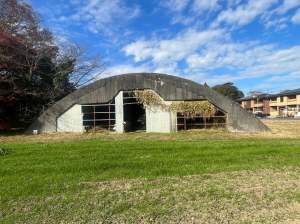
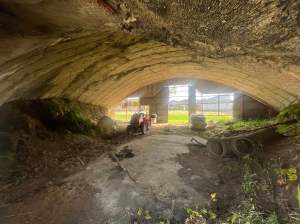
It’s 15 minutes east of the station on foot and can be accessed easily across a grassy field. There is not too much to see inside the bunker other than mud and a couple of discarded farming tools.
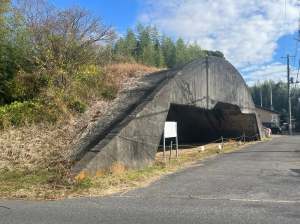
The next one was the biggest (6.7 metres tall) and most accessible (the emptiest too!) as it’s located right by the side of the road on a quiet backstreet. It’s been said that such bunkers were created by piling up earth and sand into the shape of a trench before compacting and lining it with straw and boards. Iron mesh was then stretched on top of that with cement poured over it. This is the only one with an information board detailing the history of the bunker and surrounding area.
In September 1941, just before the outbreak of the Pacific War the relocation of about 100 private homes, schools, temples, shrines and so on was enforced, and construction of the Mobara Naval Air Base began. It was constructed within two years but how it was done is quite controversial as it allegedly involved the forced labor of Korean residents in Japan as well as both Agricultural School and Junior High School students.
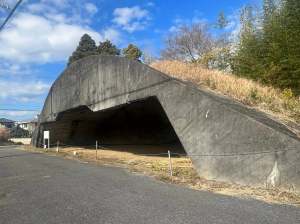
The United States occupied the airfield at the end of WWII before the Japan Self-Defense Forces (JSDF) attempted to reoccupy it in 1954. The details of what happened then are all a bit murky but some years later the site was used to build Mobara Junior High School to cater to the area’s rapidly increasing population.
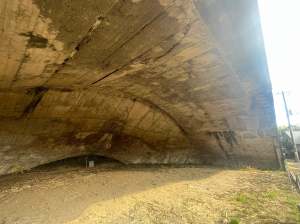
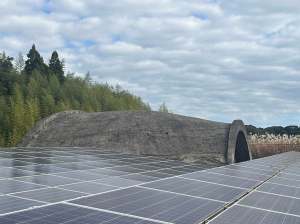
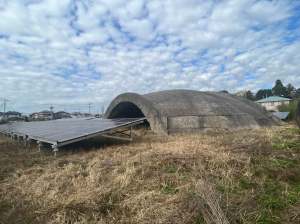
The third one may have been easily visible, but it was located in the middle of a crop field which was quite difficult to access.

I wasn’t going to give up so easily though and as it was a dry, sunny day it wasn’t so bad for wading through the tall grass for a few minutes via a side entrance. Needless to say, there wasn’t actually too much to see up close other than admire the formation and shape of the empty bunker.
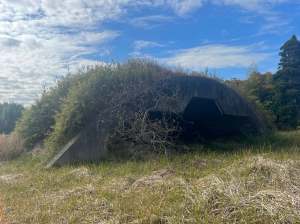
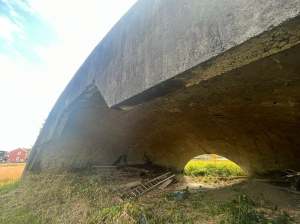
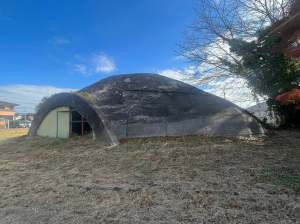
It should be added that the majority of these bunkers are no longer marked on Google Maps but I added them a few years back when a fellow b-grade spot friend of mine posted on social media about going there. The next one was really difficult to find, and the maps app didn’t take me to the right place but by chance I spotted it and backtracked a bit to get nearer. Not too close though as it looked like it may have been private property and part of someone’s garden.
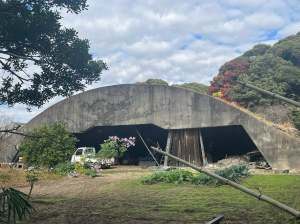
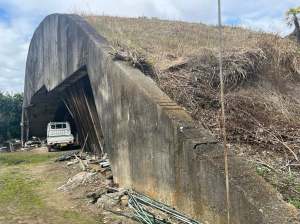
The penultimate bunker was the smallest and also a little tricky to track down as it wasn’t exactly where Google said it was. Luckily, I spotted it early on and could reach it without too much trouble albeit only viewing it through a fence.
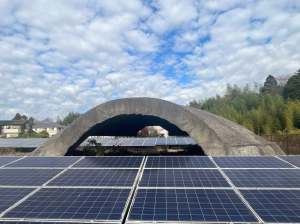
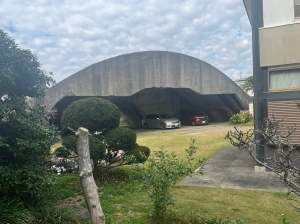
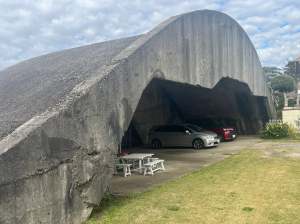
The final bunker I visited also seemed to be part of someone’s garden and doubling up as a unique garage. One theory for many of them still remaining is that it’s actually quite difficult to destroy something so well-constructed.
After returning from Chiba and getting in touch with the guy who alerted me to these bunkers, I found out there were a few others closer to home in the western provinces of Tokyo. They are in Mitaka and Fuchu so next time I go to watch football at Ajinomoto Stadium or AGF Field then I will try and make time to see them as they are reminders of the past that should be preserved.
Bonus: The main reason I was ever in that part of Chiba prefecture was to see a football match on the final day of the J2 season when the vast majority of games had something riding on them. This one could’ve been a promotion party for the home side and indeed they did all they had to do but results elsewhere ultimately meant they had to settle for a play-off spot.

Although I’m a fan of Chiba rivals Kashiwa Reysol, I don’t really have too many negative feelings towards JEF United but I do refuse to support them so was in with the Imabari fans on this occasion. There wasn’t too much to celebrate in the away end as JEF ran riot but ultimately missed out on automatic promotion. However, they did end up getting promoted via the play-offs.
Final Score: JEF United 5-0 FC Imabari
Click here to read ‘Tokyo Daytripper: The Relics of the Japanese Army’s WWII Military Facility’
Click here to read ‘Tokyo Daytripper: A Uniquely Designed Observation Platform & WWII Ruins’
Click here to read ‘Tokyo Daytripper: WWII Damaged Building In A Tokyo Park’
Click here to read ‘Tokyo Daytripper: Yoshimi Hyakuana WWII Cliff Tombs’

 Tokyo Fox (東京狐)